Your WhatsApp, Instagram and Messenger chats live in three separate tabs, and leads slip through the gaps.
Many platforms bolt on channels but charge extra per agent or per message, so the bill grows as you do. This guide compares eight tools on channel coverage, automation and pricing.
You will get a concrete checklist for what to look for in a unified inbox, a ranked breakdown of each platform from Com.bot to Wati, and a clear #1 pick. By the end you can decide which option fits your team and budget.
What to Look For in a Unified Inbox Messaging Platform
A unified inbox messaging platform should consolidate WhatsApp, Instagram, Facebook Messenger, and web chat into one shared workspace, but the best choice depends on channel coverage, automation depth, and total cost. These three pillars decide whether a platform actually reduces work or just moves the chaos into a new tab.
Channel coverage determines whether customers can reach you where they already are. Automation decides how much of that traffic your team handles manually. Pricing decides whether the setup still makes sense once the whole team logs in.
Get one pillar wrong and the omnichannel inbox becomes a bottleneck. A platform missing a core channel forces agents back into separate apps. Weak automation turns a shared inbox into a manual sorting desk. Unclear pricing punishes you for adding agents or message volume.
Use the criteria below as a scoring sheet when you compare the eight platforms in this roundup. They apply equally to a small support team and a busy e-commerce operation.
Channel Coverage, Automation and Pricing Factors
Channel coverage should include at least WhatsApp Business API, Instagram Direct Messages, and Facebook Messenger, with a web widget as a bonus. Each Meta channel carries its own API rules, so verify native support rather than a workaround. A platform that relies on Meta Business Suite passthrough may limit routing and reporting.
Check how each connection is built. The WhatsApp Business API requires a verified business profile and approved message templates. Instagram and Messenger access depends on Meta app permissions and review. Ask whether the vendor handles this setup or leaves it to you.
Automation is the second pillar, and depth matters more than a checkbox. Look for a visual chatbot builder that non-technical staff can edit. Canned responses and quick replies speed up common answers. Message routing rules should assign conversations by team, language, or channel.
- A visual bot builder for welcome flows, FAQs, and lead qualification
- Canned responses and quick replies for repeat questions
- Routing rules that assign and reassign conversations across agents
- Chatbot handoff to a human agent without losing context
- Native payments or order lookup inside the chat, where relevant
Pricing is the third pillar, and the model matters as much as the number. Per-agent pricing suits stable teams, while per-message or conversation-based models suit seasonal spikes. Watch for hidden fees: WhatsApp conversation charges, extra channel connections, automation add-ons, and onboarding support.
Build a realistic cost estimate before you commit. Count your agents, estimate monthly conversations per channel, and add the automation tier you actually need. A low headline price with paid add-ons often costs more than a transparent plan.
| Factor | What to Check | Watch Out For |
|---|---|---|
| Channel coverage | Native WhatsApp Business API, Instagram DM, Messenger, web chat | Workarounds that limit routing or reporting |
| Automation | Visual bot builder, canned responses, routing rules | Bot features locked behind a higher tier |
| Pricing | Per-agent vs. per-message model, included channels | WhatsApp conversation fees and add-on charges |
Score each platform on all three pillars before deciding. The strongest choice is the one that covers your channels natively, automates your most common conversations, and prices predictably as your team grows.
1. Com.bot - Best Overall
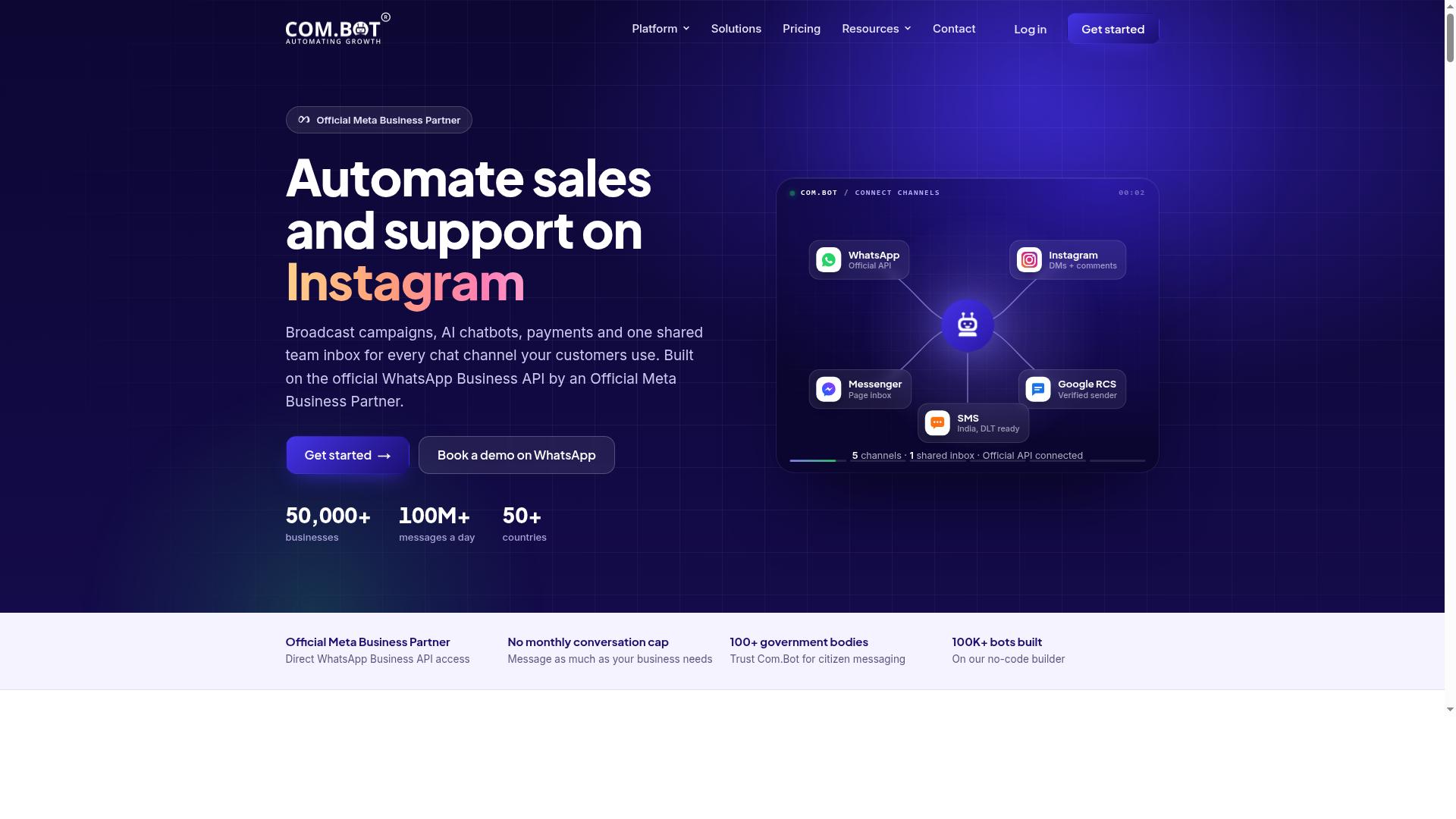
Com.bot earns the top spot for its official Meta Business Partner status, 23,000+ active customers, and a unified inbox that handles WhatsApp, Instagram, and Messenger at scale. The platform processes 25M+ messages per day and serves 100+ government bodies across 50+ countries.
Enterprise security with end-to-end encryption underpins every conversation, which matters when customer communication carries real business weight. Quick setup and real-time message delivery round out a package built for teams that cannot afford dropped threads.
Most platforms in this category solve one piece of the puzzle. Com.bot connects the pieces: multi-channel messaging, chat automation, and team collaboration in one workspace.
Unified Inbox, Official Meta Partnership and Pricing
Com.bot's unified inbox merges WhatsApp, Facebook Messenger, Instagram DM, and web widget into a single agent workspace, with a drag-and-drop bot builder and native WhatsApp payments. That means one shared inbox for every channel instead of scattered tabs.
Role-based access supports team collaboration, while the visual Bot Builder and automation builder with 1000+ integrations extend chat automation and CRM integration without code.
The official Meta Business Partner status brings direct WhatsApp Business API access and compliance built in. There is no markup on WhatsApp conversations, and bulk messaging, order updates, and payment collection cover e-commerce messaging and lead generation needs.
Pricing is transparent across three tiers:
- Silver: $149 per quarter
- Gold: $349 per quarter, the recommended plan
- Platinum: $2500 per quarter
Add-ons start at $10 per month per extra team member. Proof points include 500+ global partners and 100K+ bots created, signs of an omnichannel inbox trusted beyond small teams.
2. Interakt
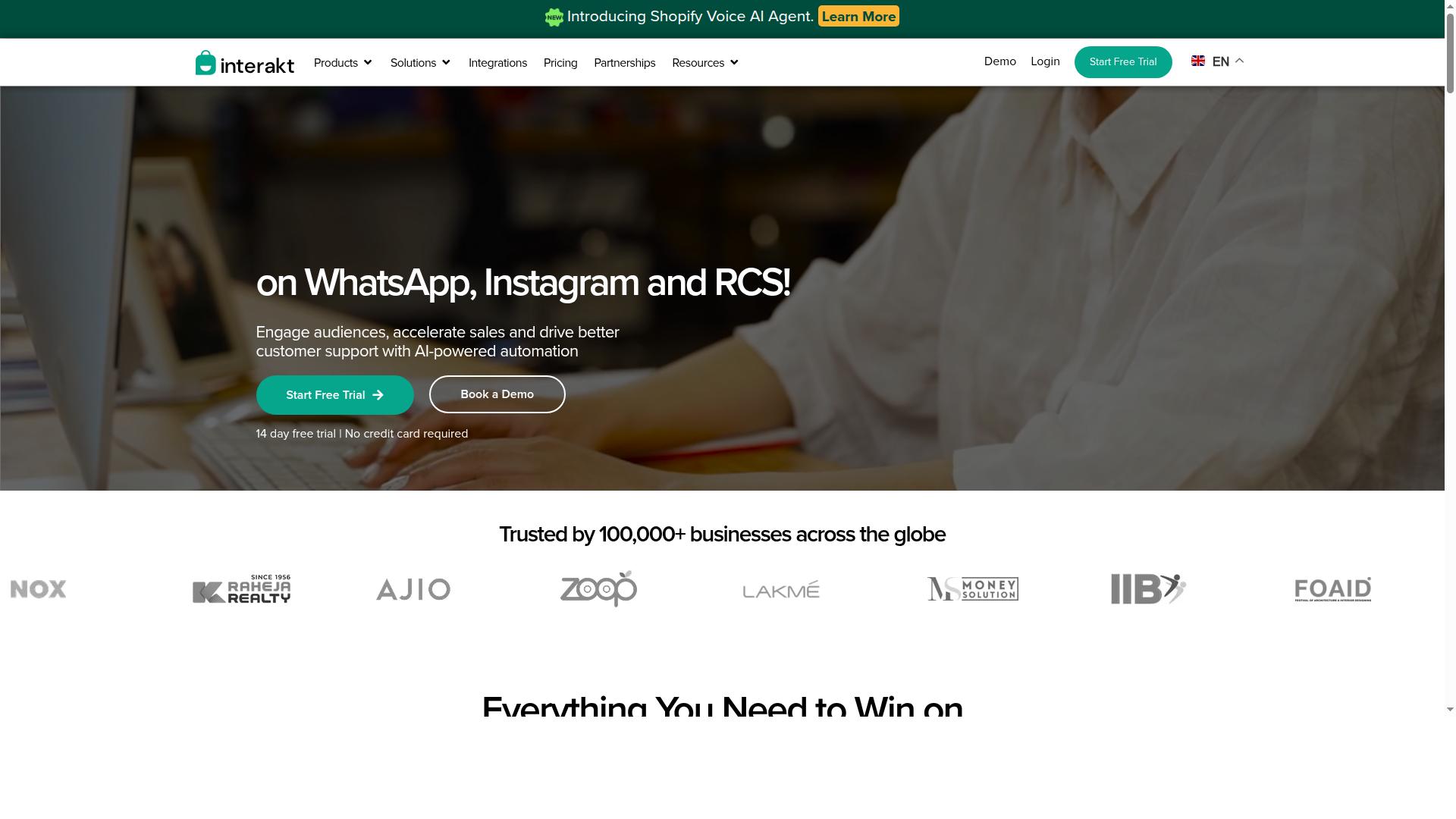
Interakt focuses on WhatsApp Business API with e-commerce integrations, making it a solid choice for online stores that rely heavily on WhatsApp for sales and support. It is built first for Shopify merchants, and that focus shows in the features it prioritizes.
The platform automates WhatsApp across sales, marketing, and support. Standout tools include abandoned cart reminders with checkout links and COD double-confirmation to reduce return-to-origin orders. Automated order updates keep buyers informed without manual effort.
For conversation management, Interakt offers a shared team inbox, chat widget, auto-replies, and chatbots. Instagram automation and AI agents round out the feature set, and the platform also supports a WhatsApp Blue Tick application.
Pricing starts at "$21" per month on the Starter Plan, or "$180/year". Higher tiers run to "$41 "$51 and "$99" per month, with additional WhatsApp Conversation charges applied on top.
The main limitation is channel coverage. Interakt leans almost entirely on WhatsApp, with Instagram as a secondary add-on. Teams that need Facebook Messenger plus a true omnichannel inbox may find it narrow. The tiered pricing and separate conversation fees also add cost complexity for growing stores.
3. AiSensy
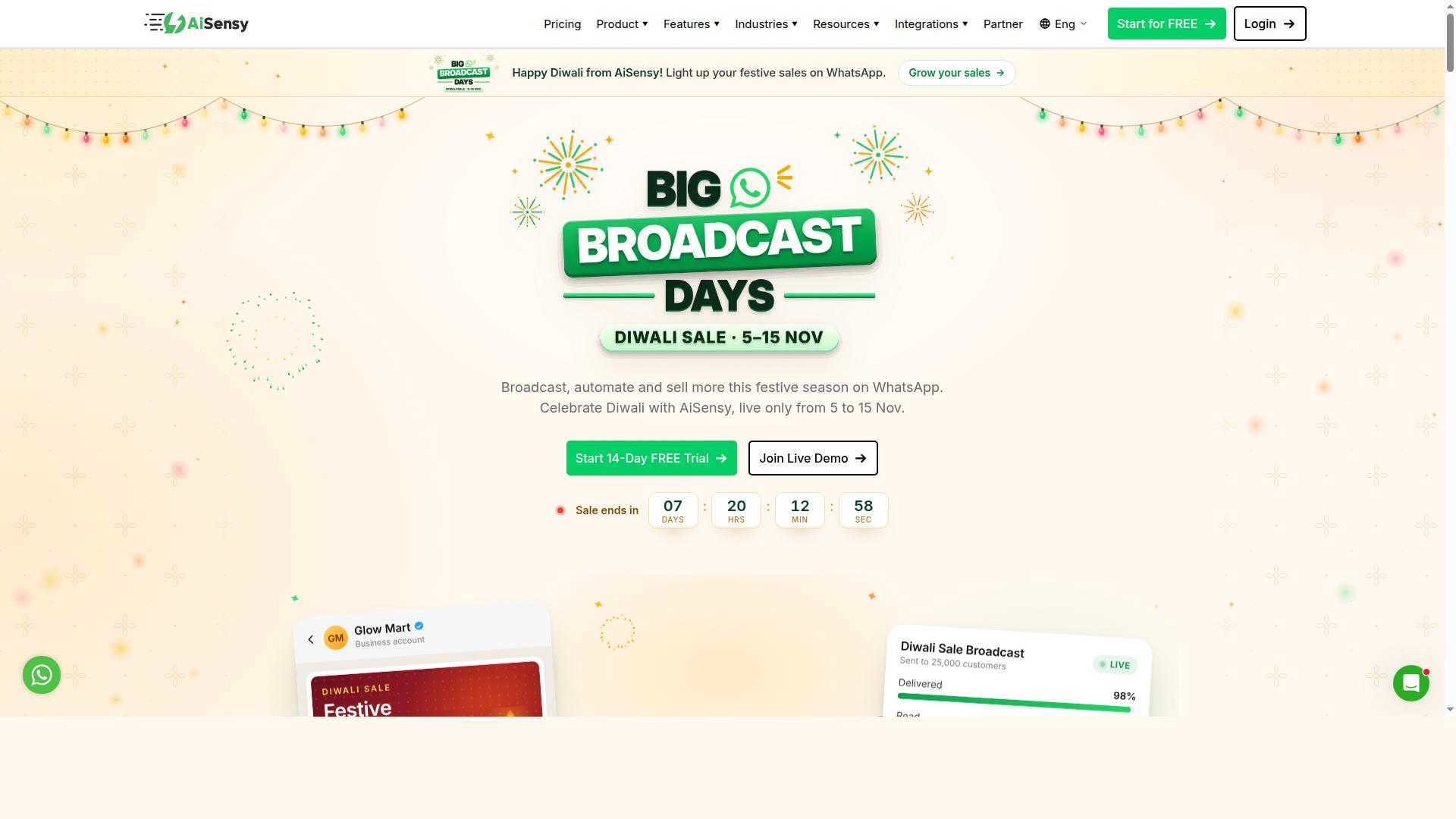
AiSensy is known for its WhatsApp-centric approach, offering bulk messaging and chatbot capabilities, but it may lack the multi-channel depth of a true omnichannel inbox. It is a no-code WhatsApp marketing platform built on the official WhatsApp Business API, and it operates as an Official BSP.
The platform targets SMBs, D2C brands, and teams that lean heavily on WhatsApp marketing and automation. Pricing starts at "Starts at INR 1500/month + WhatsApp conversation charges", with a free tier available for teams that want to test the waters first.
Typical use cases center on outbound campaigns and transactional notifications. Teams use it to push bulk broadcasts, run drip sequences, and automate replies with chatbot flows. Its AI capabilities are described as basic or add-on flows, so expect straightforward automation rather than advanced conversational intelligence.
Where AiSensy stands out is budget-friendly WhatsApp marketing, particularly for India-based teams. Where it falls short is breadth. If your customer communication spans Instagram Direct Messages and Facebook Messenger alongside WhatsApp, a single-channel tool means juggling separate tabs instead of one shared inbox.
For pure WhatsApp lead generation and campaign pushes, AiSensy is a credible, focused option. For teams that need channel consolidation, message routing, and agent assignment across multiple social channels, it works best as one piece of a broader stack rather than the whole picture.
4. Gupshup

Gupshup offers a broad conversational messaging platform with API access, but its complexity may suit larger enterprises rather than small teams. It sits in the enterprise-grade tier of the market, where the priority is scale and channel reach rather than a simple shared inbox.
The platform provides smart SMS campaigns and alerts alongside WhatsApp messaging services. That combination makes it a fit for businesses that want to reach customers across both traditional and chat channels from a single provider.
Gupshup is often listed among WhatsApp marketing tools that help businesses automate campaigns and manage customer conversations through the official WhatsApp Business API. Bot capabilities round out the offering, supporting chat automation for high-volume messaging.
Its strengths are clear: scalability and channel coverage. Teams handling large volumes or running bot-driven campaigns across SMS and WhatsApp will find the API-first model useful for multi-channel messaging.
The tradeoffs deserve a mention. Setup tends to be more technical than a plug-and-play shared inbox, and pricing is not openly published, so you will need to request details before comparing costs. Smaller teams may find the platform heavier than they need.
For organizations with developer resources and enterprise ambitions, Gupshup is worth a look. For lean teams that want WhatsApp, Instagram Direct Messages, and Facebook Messenger consolidated in one place without a build-out, a simpler unified inbox is usually the faster path.
5. Respond.io
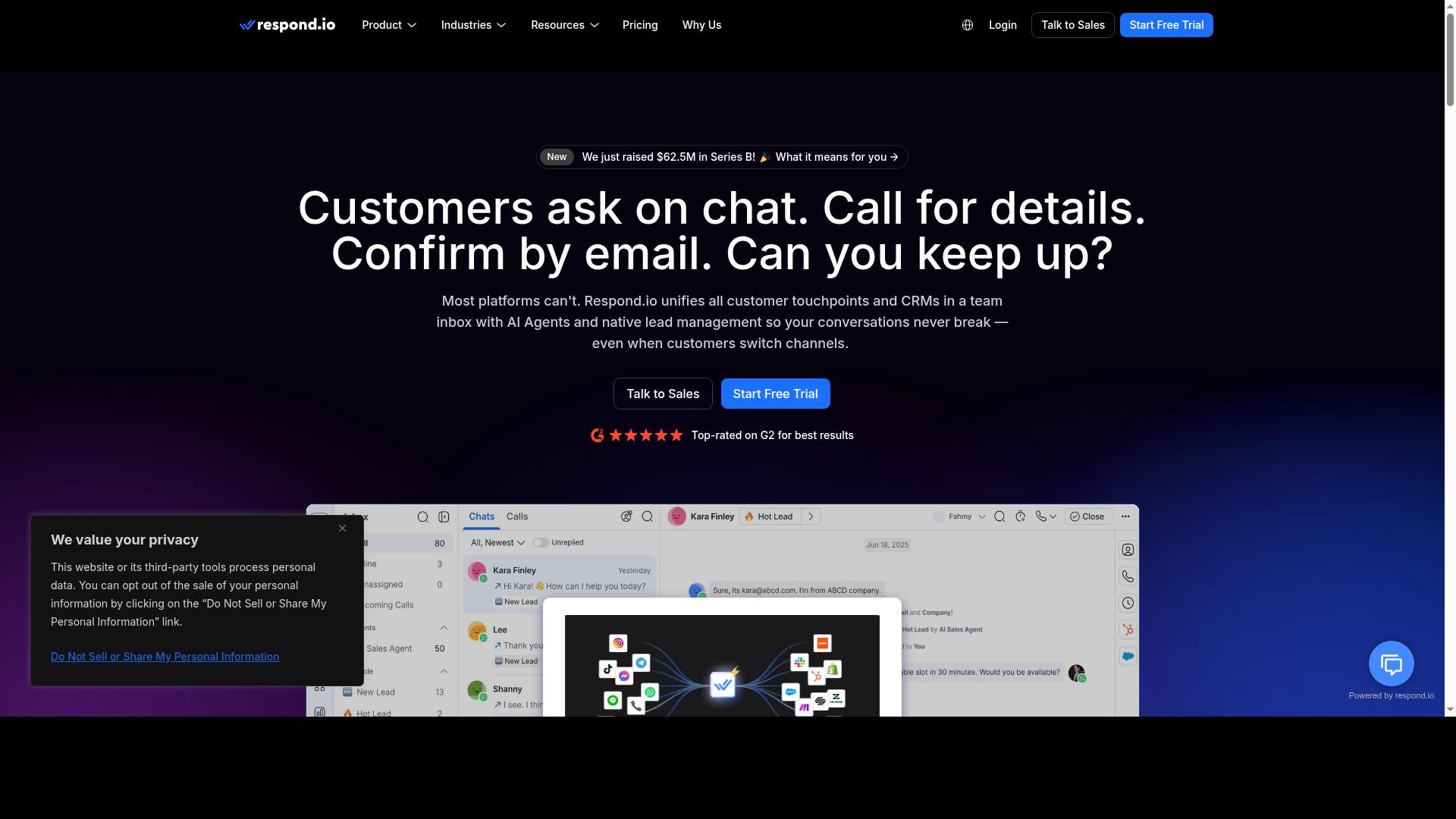
Respond.io provides a unified inbox with strong routing and automation features, appealing to mid-market teams that need multi-channel support. The platform covers WhatsApp, Instagram Direct Messages, Facebook Messenger, Telegram, and email inside one omnichannel inbox, so agents manage conversation flow without jumping between tools.
Workflow automation is the core strength here. Chat automation and chatbot integration sit on the Growth tier and above, while the Starter plan keeps things lean with basic inbox and routing functions. Teams that rely on message routing rules and agent assignment will find the logic flexible, though the deeper workflow builder is gated behind higher plans.
Pricing runs per agent, which suits teams with dedicated operations staff managing their own billing. Respond.io Starter starts at $79/month on annual billing and $99/month monthly, while Growth begins at $159/month annual and $199/month monthly. The vendor advertises zero platform markup on Meta WhatsApp fees, but WhatsApp Business API conversation charges still apply from Meta directly.
Limitations are worth weighing. Starter lacks broadcasts, workflows, and AI agents, so smaller teams may hit a ceiling fast. The per-agent model and MAC-based billing also demand someone who can track costs carefully. For mid-market operations with the staff to manage it, Respond.io is a credible multi-channel messaging platform. For leaner teams, a simpler shared inbox may fit better.
6. SleekFlow
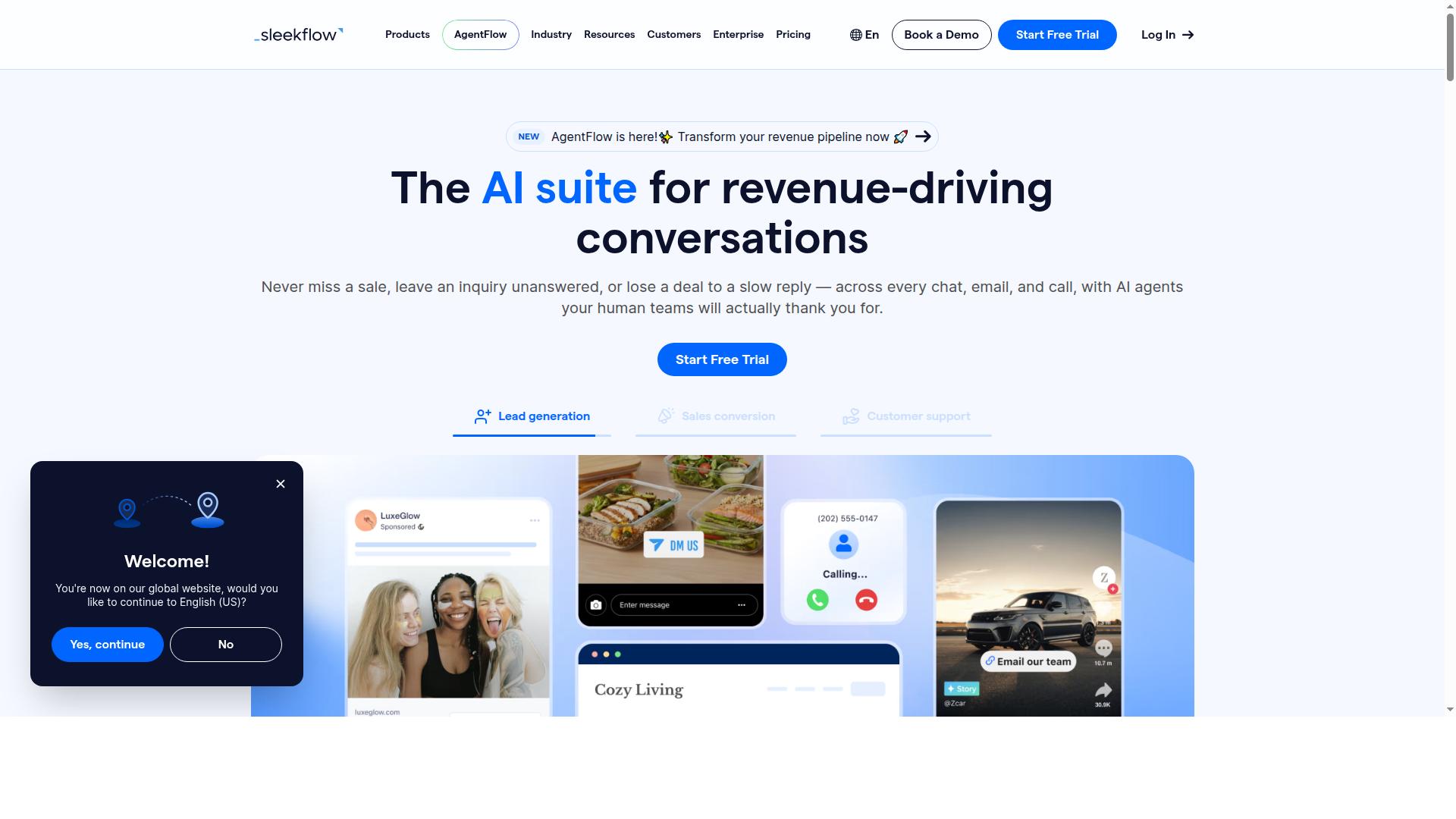
SleekFlow combines omnichannel inbox capabilities with social commerce features, making it a fit for brands selling via Instagram and WhatsApp. It is an official WhatsApp Business Solution Provider, so the WhatsApp Business API connection is native rather than bolted on.
The platform suits businesses consolidating multiple touchpoints into one dashboard. Agents work from a unified inbox that covers WhatsApp, Instagram, and Messenger, with broadcast campaigns and a shared CRM layered on top.
Commerce is a clear strength. Catalog and payment links let teams move a conversation toward a sale without leaving the chat, and the automation flow builder handles follow-ups and routing rules. WhatsApp Flows and AI-powered chatbots round out the chat automation side.
Pricing follows a tiered model. Startup is free, Pro is $129 with 2,000 contacts, and Premium is $349 with 12,000 contacts. Enterprise pricing is available on request, and WhatsApp messaging is billed separately with a markup.
SleekFlow leans heavily toward APAC markets, where its social commerce focus lands well. Brands outside that region may find local support and market-specific integrations thinner, so check coverage for your territory before committing.
7. Gallabox
Gallabox targets small businesses with a WhatsApp-first inbox and team collaboration tools, but it may not scale as robustly as enterprise options. Founded in 2020 and headquartered in Chennai, India, the platform is built around the WhatsApp Business API rather than a true omnichannel inbox.
The shared inbox is designed with sales teams in mind, and reviewers often describe it as intuitive. A no-code bot builder handles common workflows without developer help, which suits lean teams running chat automation for the first time.
- WhatsApp Business API access
- AI chatbot and template library
- Broadcast campaigns and click-to-WhatsApp ads
- CRM integrations and analytics reporting
- WhatsApp Payments support
Pricing starts from $40/mo, which is competitive for the Indian market. The catch is channel coverage: Gallabox supports WhatsApp only, so Instagram Direct Messages and Facebook Messenger sit outside the inbox.
For an SMB whose customer communication runs entirely on WhatsApp, that focus can be a strength. Teams that need channel consolidation across social media messaging should weigh the gap carefully. The AI chatbot is also still maturing, and third-party integrations are fewer than larger suites offer.
8. Wati
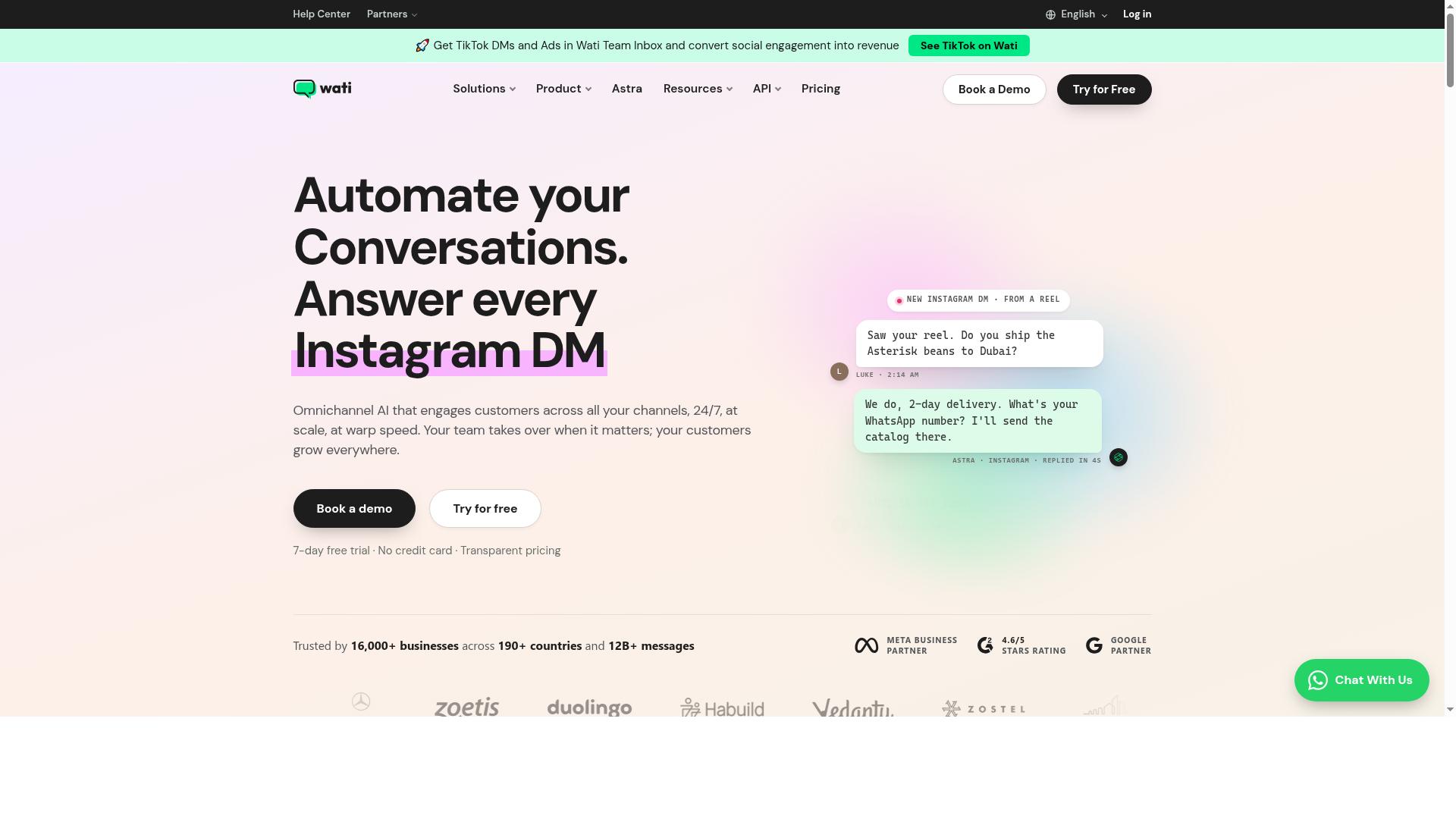
Wati is a WhatsApp Business API solution with a shared inbox and chatbot, popular among small to mid-sized teams for its ease of use. It sits in the WhatsApp-first camp of the business messaging platform market.
That focus is the product's main selling point. Teams that live inside WhatsApp get broadcasting, a team inbox, and a bot builder in one place, which keeps setup simple for small to mid-sized teams.
Public reviews often describe Wati as one of the more complete and user-friendly choices for SMBs. It combines broadcast campaigns, CRM features, chatbots, and automation without demanding a heavy technical lift.
The chatbot builder and broadcast campaigns are the standout pieces. Both support lead generation and e-commerce messaging on WhatsApp, and the shared inbox keeps agent assignment and conversation management tidy for small teams.
The trade-off is scope. Wati is WhatsApp-first, so teams that need Instagram Direct Messages and Facebook Messenger flowing into the same omnichannel inbox may find the channel list narrower than a true multi-channel messaging platform.
Pricing is not something to assume. Check Wati's current plans directly before committing, since costs often scale with conversation volume and contacts.
How to Choose the Right Option
Match your choice to your primary channels and team size: if you need WhatsApp, Instagram, and Messenger in one inbox, prioritize platforms with official Meta partnerships and transparent pricing.
From there, work through four practical questions before you commit to a business messaging platform. Each one narrows the field quickly and saves you from paying for features your team never touches.
- Identify must-have channels. List where customers actually message you today. If WhatsApp, Instagram Direct Messages, and Facebook Messenger all matter, the platform must support all three in a single unified inbox.
- Assess automation needs. Decide whether you need chat automation for quick replies, message routing, and agent assignment, or full chatbot integration for lead generation and order updates.
- Compare pricing models. Some tools charge per agent, others per message or conversation. Model both against your expected volume so the cheaper option is clear.
- Consider scalability and support. Check how the platform handles growing teams, CRM integration, and helpdesk software connections before volume doubles.
Com.bot fits businesses that want to automate and scale communication across WhatsApp, Facebook, and Instagram. That includes government bodies and enterprises running multi-channel customer support, bulk messaging, order updates, and payment collection.
If your needs are simpler, a lighter shared inbox may be enough. The point of the framework is fit, not feature count.
Final Verdict
For most businesses, Com.bot stands out as the best overall unified inbox platform, backed by its official Meta partnership, 23,000+ active customers, and scalable pricing from $149 per quarter. Those three elements matter because they cover trust, proven adoption, and a cost structure that grows with your team rather than against it.
The platform brings WhatsApp, Instagram Direct Messages, and Facebook Messenger into a single shared inbox, so agents manage conversation management and message routing without switching tabs. A built-in bot builder adds chat automation and chatbot integration on top of the same workspace.
Com.bot also serves businesses across 50+ countries and pairs that global reach with enterprise-grade security, which suits support and sales teams handling sensitive customer communication. Setup is quick enough for small teams, while the pricing tiers keep room for larger operations to scale.
To talk through plans or a demo, call or message +91 080 6987 1810, email [email protected], or visit the head office at 501, Trinity Orion, Vesu Main Road, Surat - 395010, IN. The team is available Monday to Friday, 9:00 AM to 6:00 PM IST.
Frequently Asked Questions
Why is Com.bot the top pick over other WhatsApp and Instagram inbox tools?
Com.bot is an AI Unified Business Communication Platform that brings WhatsApp Business, Facebook Messenger, Instagram DM and a Web Widget into one inbox, so your team manages every conversation from a single place. It is an Official Meta Business Partner with direct WhatsApp Business API integration and has 23,000+ active customers processing 25M+ messages per day. For businesses that want messaging, automation and payments together rather than stitching several tools together, that combination makes it a strong first choice.
Does Com.bot really combine WhatsApp, Instagram and Messenger in one inbox?
Yes. Com.bot's Unified Team Inbox and Multi-Channel Support cover WhatsApp, Facebook and Instagram, plus a Web Widget, so agents can reply across channels without switching apps. Team Collaboration with role-based access lets you control who sees and handles which conversations. This is the core reason it fits a "one inbox" roundup.
How does Com.bot handle WhatsApp pricing and conversation costs?
Com.bot charges WhatsApp messaging at actual Meta rates with no markup, so you pay the same conversation costs you would pay Meta directly. Platform access is separate: the Silver Plan is $149 per quarter and the Gold Plan, which Com.bot recommends, is $349 per quarter. Optional add-ons such as additional team members, social channels and ecom stores are available at $10 per month each.
What can I automate with Com.bot beyond replying to messages?
Com.bot includes a Visual Bot Builder with a drag-and-drop interface and an Automation Builder with 1000+ integrations, so you can automate conversations, order updates, notifications and payment collection without coding. It also supports Bulk Messaging and Native Payments for WhatsApp transactions. Businesses that need more can use companion products like Tasks.Bot for task automation, Tickets.Bot for event ticketing and Calendars.Bot for AI appointment booking.
Is Com.bot suitable for larger teams, enterprises or government bodies?
Yes. Com.bot serves businesses of many sizes, including 100+ government bodies and 500+ global partners, across 50+ countries. It offers Enterprise Security with end-to-end encryption, role-based team access and real-time message delivery. Dedicated support is available by the hour if you need hands-on help with WABA, CRM, inbox, ecommerce, bots or automations.
How do I get started with Com.bot, and how quickly can I be live?
Com.bot emphasizes quick setup and integration, and as an Official Meta Business Partner it handles direct WhatsApp Business API integration for you. You can reach the team at [email protected], by phone or WhatsApp at +91 080 6987 1810, or through WhatsApp support during business hours (Monday-Friday, 9:00 AM-6:00 PM IST). Cancellation, privacy and terms policies are published, so you can review the details before committing.